Starter guide
Why an EOB is a starting point not a payment demand
August 7, 20265 min read

Starter guide
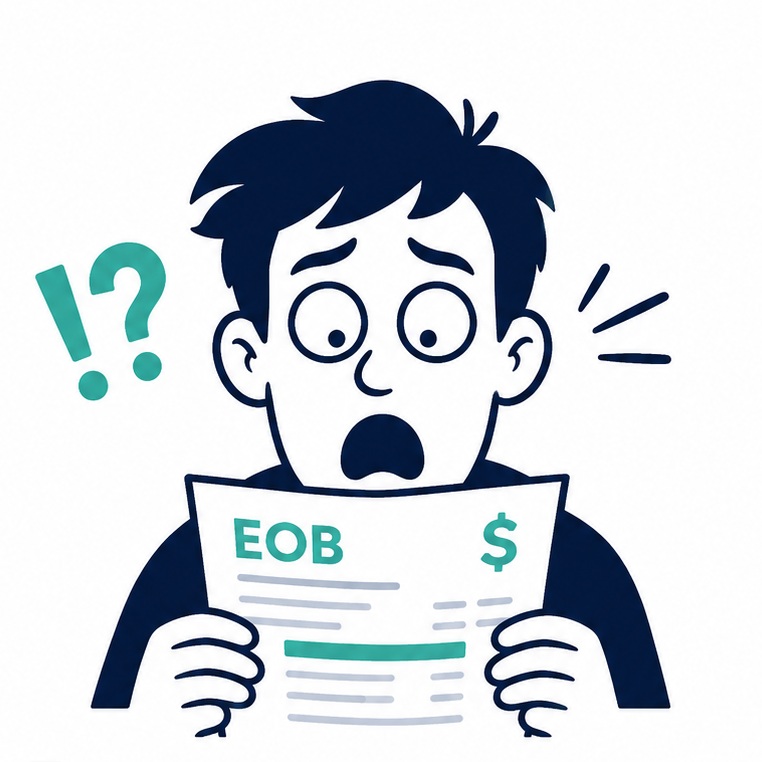
An explanation of benefits can look like a bill wearing a fake mustache. It has dollar amounts, provider names, service dates, and sometimes alarming denial language. No wonder people freeze when one shows up. The safer way to read it is as a starting point, not a payment demand.
But an EOB is usually not asking you to pay right then. It is showing how your insurance processed a claim. That difference matters, because reacting too fast can make a confusing bill even harder to untangle.
An EOB is a notice from your insurance company that explains how a medical claim was processed. It usually shows what the provider billed, what the insurance plan allowed, what insurance paid, what was adjusted, and what amount may be listed as your responsibility. That makes it a useful starting point for questions, not a payment demand by itself.
That does not make it the same as a provider bill.
A bill usually comes from the doctor, hospital, lab, imaging center, or another provider asking for payment. An EOB usually comes from your insurer explaining the claim activity. Sometimes the two match neatly. Sometimes they do not. Sometimes one arrives weeks before the other.
Think of the EOB as a map of the claim, not the final word on what you should do next. The point is to compare it with the provider bill before you treat any number as final.
If you want a broader walkthrough, see What an EOB means before you pay a medical bill.
Most EOBs use slightly different layouts, but the same ideas show up again and again.
The trick is not memorizing every term. The trick is knowing which numbers connect to a real bill and which ones are just part of the claim math.
For more on that one scary line, read What patient responsibility means on an EOB.
An EOB can list patient responsibility before you have received a provider bill. That number may be useful, but it is not always a payment request by itself. If a bill has not arrived, you may still need to wait for the provider side of the paperwork or ask the provider how they are applying the insurance information.
Insurance processing and provider billing do not always move at the same speed. Your EOB might show up first, then the bill comes later. Or a bill might show up before the EOB is easy to find in your insurance portal. Annoying? Yes. Rare? Not really.
Denial language can sound final and harsh. But an EOB denial line may refer to only one part of a claim, a coding issue, missing information, prior processing, plan rules, or something else. It is a reason to slow down and ask questions, not a reason to assume you understand the whole claim from one phrase.
One visit can turn into several claim lines. A hospital visit might involve the facility, physician, lab, imaging, anesthesia, or outside groups. The EOB may group, split, or label those services in ways that do not look like your appointment memory. That does not automatically mean something is wrong, but it does mean you should compare dates, provider names, and service descriptions carefully.
If the EOB and the bill are confusing, keep your questions narrow. Broad questions like Why is this so expensive? often lead to vague answers. Specific questions usually work better.
Try asking:
You are not trying to become a claims analyst overnight. You are trying to get enough clarity to avoid guessing.
Before treating an EOB like a bill, run through this simple check:
If the numbers do not match, your next step is usually to compare documents line by line rather than argue from memory.
This article is for general educational purposes only. It is not medical, legal, financial, or insurance advice. Oh My EOB does not determine coverage, verify billing accuracy, decide legal rights, or tell you whether a charge is owed. For decisions about your specific plan, claim, bill, or rights, contact the insurer, provider billing office, plan documents, or a qualified professional.
An EOB is not harmless paperwork, but it is also not always the thing asking you to pay. Treat it like a starting point and claim explanation, not an automatic payment demand. Use it to spot the service date, processed amounts, possible patient responsibility, and the questions you need answered.
The patient mistake is reacting to the biggest number on the page. The better move is slower: identify what the document is, match it against the bill, and ask targeted questions before making assumptions.
If you want help translating the language before you make calls, Oh My EOB can help you organize the document in plain English.
Paste your bill, EOB, or denial letter into Oh my EOB! for a plain English explanation and next-step checklist.
Try the free explainer