Oh my EOB logoOh my EOB!

Free PDF guide

Before You Pay: A Plain English EOB Checklist

A printable, plain English checklist for slowing down an EOB, matching it to the provider bill, and deciding what deserves a question before money leaves your account.

25 pagesVersion 1.0No email delivery
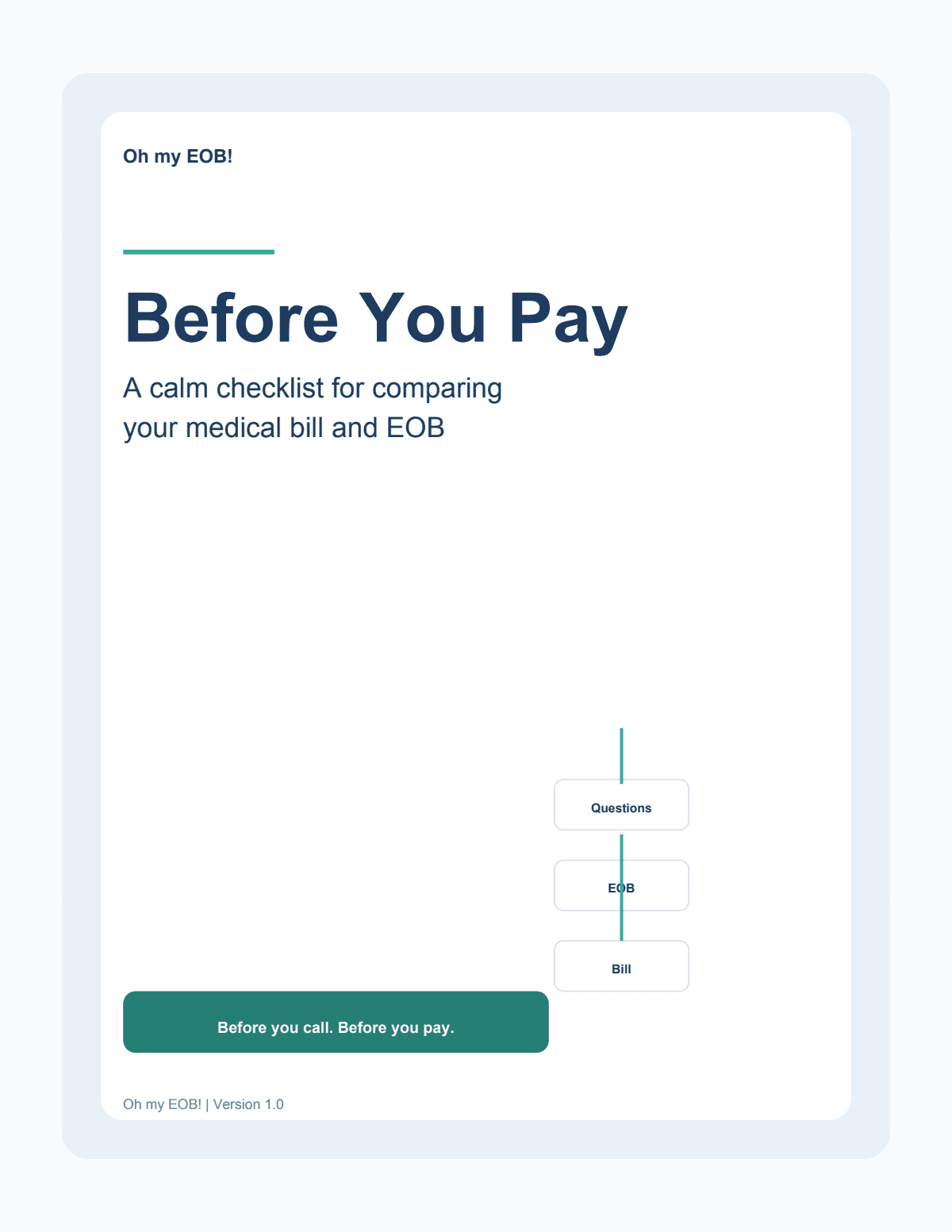
Before You Pay: A Plain English EOB Checklist cover preview

We store your email to unlock this guide here. No account is created and no guide email is sent. Read the privacy note.

Inside

What the checklist helps you do

Separate the provider bill from the insurance EOB.

Compare billed, allowed, paid, adjusted, and patient responsibility amounts.

Spot when a balance deserves a question before payment.

Prepare calmer notes for a billing or insurance call.

Before you pay

Use the EOB as a comparison tool, not a payment button.

This free EOB sample PDF is for the moment when a provider bill, portal balance, or insurance explanation makes the next step feel unclear. It does not tell you whether a balance is legally owed. It helps you slow the paperwork down enough to ask a more precise question.

Match the documents

Start by lining up the service date, provider name, patient name, claim number, and bill account number. If those details do not match, the balance may be tied to a different claim, another provider, or a statement that has not caught up with insurance processing.

Compare the amounts

The checklist walks through billed amount, allowed amount, adjustment, insurance paid, deductible, coinsurance, copay, denial notes, and patient responsibility so you can see which number the provider bill appears to be using.

Ask one clear question

Instead of calling with “this looks wrong,” you can ask whether the insurance payment posted, whether the contractual adjustment was applied, why a denial code appeared, or which claim created the balance on the bill.

Who it helps

Built for the awkward gap between the EOB and the bill.

The guide is most useful when an EOB says “you may owe,” but the provider bill is higher, lower, missing insurance activity, or simply hard to match. It gives you a plain-English sequence for comparing documents before you pay, before you dispute, and before you spend a long call trying to find the right words.

You can also use it when insurance paid zero, when a claim line was denied, when a deductible or coinsurance amount appears unexpectedly, or when the provider name on the EOB does not look like the office you visited. The point is not to solve every insurance rule on your own. The point is to identify the exact line, amount, and question that need confirmation.

Keep the checklist beside the EOB and the provider bill. Mark what matches, circle what does not, and write down the specific question you want answered before you call the insurer or the provider billing office.
Chapter map

  1. 1Why an EOB is not automatically a bill
  2. 2The numbers to compare before paying
  3. 3Common mismatch patterns worth questioning
  4. 4A call script for provider and insurer follow-up
  5. 5A one-page pre-payment checklist

Access details

Enter your email on this page, and the next screen gives you the PDF download immediately. The guide is not emailed, and there is no account, password, CRM sync, webhook, or email service behind this V1 flow.

Duplicate signups are handled idempotently, so a returning reader can use the same email without creating multiple records for the same guide.

Related reading

Useful before you pay or call.

View all articles